Speaking

A preacher’s charisma, a professor’s erudition, a statesman’s poise.

John Wood Jr. has inspired, edified, and awed audiences across America for more than twelve years.

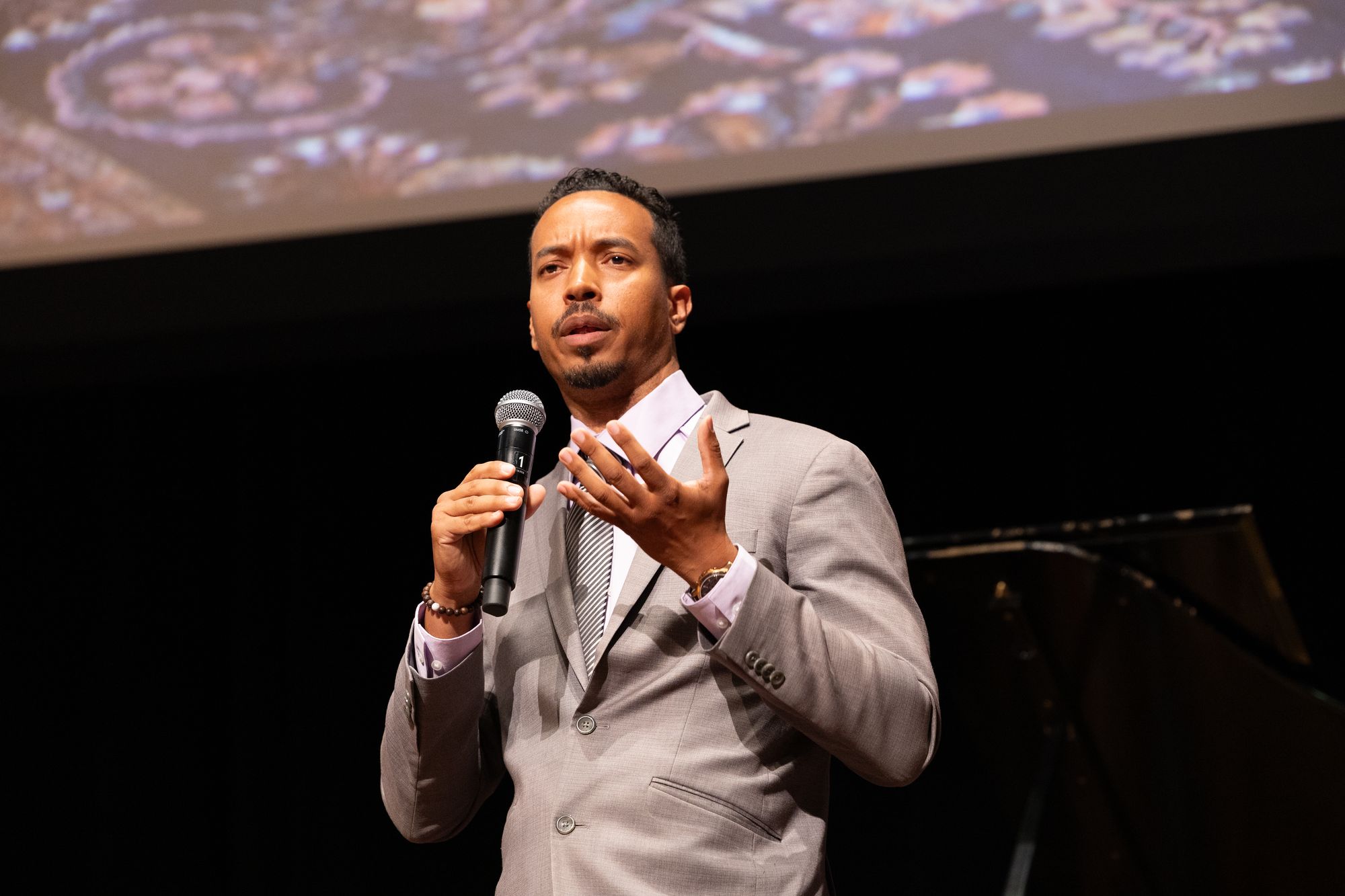
John Wood Jr. addressing an audience with a microphone

His rare oratorical talent is marked by an extemporaneous style that combines the charisma of a preacher, the erudition of a professor, and the poise of a statesman into deliveries that are invariably customized to speak to specific audiences across the widest possible cultural and institutional spectrum.

Wood’s audiences include universities, think tanks, foundations, corporations, civic organizations, associations of elected officials, religious organizations, and more. Each engagement reliably expands the social imagination of Wood’s audience, leaving listeners looking at themselves and the world differently than they did before.

John speaks extemporaneously and tailors every talk to its audience — he works closely with hosts in advance to understand the room, the goals, and the occasion, to deliver an experience that is both calibrated and spontaneous.

Formats

Keynote addressesFeatured addressesPanelsModerated conversationsDebates, as moderator or participant

Signature talks

Seven subjects, each shaped to the room

The Omni-American Dream: A New Story for a Divided Nation

Best forCivic organizations, foundations, universities, interfaith convenings

Drawing on the American founding, traditionalist conservatism, the blues/jazz idiom of democratic interpretation, the Black Freedom tradition, the American Christian and multifaith tradition, and the legacy of Martin Luther King Jr., John argues that America has always been a composition of distinct traditions, and that the only path forward is to recover the story that holds them together.

He offers audiences a framework for understanding American identity that is honest about our history, rooted in a narrative of love and goodwill, and hopeful about our future. Audiences leave not with a political position, but with a larger understanding of what they already believe and how it brings their views into a shared American story with that of their neighbors.

How to Bridge the Divide: The Practice Beyond the Platitude

Best forCorporate and leadership audiences, D&I programs, civic and community organizations

Drawing on twelve years of practice in the Bridging Movement, and a lifetime spent living at the intersection of politics, race and class, he offers a specific method for genuine human encounter across ideological lines rooted in established practices of mediation and the principles of nonviolence.

Rather than asking people to suspend their convictions, it asks them to understand what the convictions of others are actually protecting — and what they share underneath. This talk is practical, direct, and often surprising. Audiences regularly report that it changes how they approach specific relationships in their professional and personal lives.

Freedom of Speech and the Imperative of Civic Virtue

Best forUniversities, civic institutions, First Amendment organizations, government convenings

Free speech is a necessary element of a free society, and stands at the core of America’s historic civic principles. But free speech policies and constitutional protections are insufficient without an approach to the practice of freedom of speech that is grounded in civic virtue.

Tying together principles which informed the civic philosophies of the Founding Fathers to Abraham Lincoln, and citing the history of the Civil Rights Movement and the philosophy of Martin Luther King Jr., Wood defends the centrality of free speech to our society while demonstrating that free speech is best defended by those who practice it in a virtuous way.

Systemic Racism and the Black Experience

Best forUniversities, corporate D&I programs, civil rights organizations, progressive and cross-partisan convenings

The conversation over race and racism has broken down in America, failing along the fault line of our opinions over whether racism remains real and pervasive in American society. John brings nuance and underappreciated history to this discussion, focusing on the post-Civil Rights Movement era to illuminate societal conditions in which key structural elements reinforcing racial inequality became more severe even as interpersonal race relations improved in the wake of integration.

In these talks, John shows how it is possible for Americans Black and white, left and right, to believe that society is becoming both more racist and less racist simultaneously — and how we can bring all Americans into a shared appreciation of our racial reality.

The Lost History of American Conservatism

Best forConservative conferences and think tanks, universities, civic and interfaith organizations

We think of conservatism as a political ideology in America. But conservatism in its roots is a tradition of thought proceeding from a belief in virtue, community, a reverence for our ancestors, and a belief in the ordering hand of the divine that transcends identification with any single political party or movement.

Wood traces the history of American conservatism to its English roots in the career of Edmund Burke, through the founding to the mid-twentieth century and beyond, and explicates a philosophical approach to conserving what is good in society that challenges liberals and conservatives alike to reclaim what has been forgotten in the disappearance of the virtuous tradition of American philosophical conservatism.

What Does It Mean to Be a Christian Nation?

Best forFaith communities, think tanks, conservative and interfaith institutions, universities

In advance of the publication of his forthcoming book The Politics of Grace: Christian Nationalism and the Legacy of Martin Luther King Jr., John interrogates the question of what it means to make America a Christian nation by contrasting different approaches to this project: specifically the modern project of Christian Nationalism, the Christian-inspired project of moral and cultural reform that was the Nonviolent Movement of Reverend Martin Luther King Jr., and the evangelical crusades of the Reverend Billy Graham.

In a tone that seeks to extend a charitable invitation to Christians across the spectrum of American politics to join together in a common project of Christian love and goodwill, Wood warns against abandoning the pluralistic ethos of the American Founding while affirming the central importance of the Christian virtues of faith, hope, and love in realizing the greater promise of America.

The Blues, the Jazz, and the American Soul: Democracy’s Hidden Idiom

Best forUniversities and humanities programs, arts organizations, African American studies departments, literary festivals, music institutions, civic and cultural convenings

America has a philosophical tradition that most Americans have never studied — not in any classroom, and not in any political text. It lives in the blues and in jazz: in the art form born of suffering and transformed into beauty, in the improvisational democracy of musicians finding harmony across difference, in the insight of Ralph Ellison and Albert Murray that Black American culture is not marginal to American identity but constitutive of it, and that the fruits of Black culture are part of the heritage of all Americans.

Drawing on the intellectual legacy of Ellison and Murray, the musical history of a tradition that runs from the Mississippi Delta to the concert halls of the world, and his own experience as a jazz musician, John Wood Jr. makes the case that the blues and jazz tradition offers America something no political philosophy has managed to supply: a living model for how a people can hold tragedy and hope simultaneously, how difference can produce beauty rather than conflict, and how the improvisational spirit at the heart of American music is also the spirit at the heart of American democracy. This is a talk that leaves audiences hearing America differently — and seeing in its music a roadmap for its renewal.

Selected venues

Rooms across the spectrum

Institutions & forums

  • The Aspen Institute (Weave the Social Fabric)
  • The Manhattan Institute
  • American Enterprise Institute
  • Global Philanthropy Forum
  • Philanthropy Roundtable
  • CPAC
  • The Nantucket Project
  • FreedomFest
  • Engage for Good Conference
  • Institute for Local Government
  • Leagues and associations of elected officials and municipal leaders

Keynotes & corporate

  • Braver Angels National Convention (keynotes 2023, 2024)
  • North American Unitarian Association (keynote 2024)
  • Citizens Climate Lobby (keynote)
  • Target Corporation
  • Lucasfilm
  • General Mills

Universities

  • UC Berkeley
  • Duke University
  • MIT
  • Purdue University
  • Colorado State University
  • Quinnipiac University
  • University of Mississippi
  • Virginia Military Institute
  • Pepperdine University School of Public Policy

For availability, fees, and the right fit for your event.

Send an inquiry or write to booking@johnwoodjr.com.

Send a speaking inquiry →